Posture & Biomechanics
The Foot Tripod: How Your Foundation Shapes Your Posture
To understand posture, we must start at the very bottom: your feet. Your feet are your only contact points with the ground, making them the foundation for…
To understand posture, we must start at the very bottom: your feet. Your feet are your only contact points with the ground, making them the foundation for your entire skeletal alignment. When this foundation is compromised, it can lead to localized discomfort or chronic pain. This is why many individuals incorporate registered massage therapy into their physical maintenance plans. If you are seeking evidence-informed care at a Burnaby massage clinic, learning about the mechanics of your feet can help you collaborate more effectively with your therapist to promote muscular ease and structural balance.
In Simple Terms: Think of your body as a house. If the foundation of the house is tilted, the walls will crack, and the roof will lean. Your feet are your foundation. Keeping them balanced helps prevent tension and promote relaxation throughout your whole body. Getting a registered massage is a great way to relieve the stress that builds up when your foundation is uneven.
1. What is the Foot Tripod?
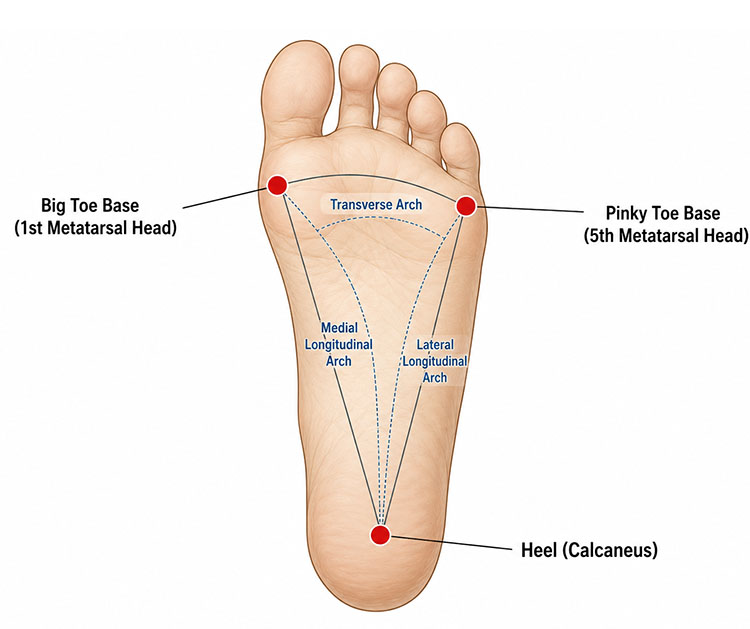
The foot does not press completely flat against the floor. Instead, weight-bearing is distributed across three primary structural points, known as the “foot tripod”:
The Calcaneus (heel bone) at the back.
The First Metatarsal Head (the base of the big toe) at the front-inside.
The Fifth Metatarsal Head (the base of the pinky toe) at the front-outside.
These three points form a stable triangular base. Between them run the arches of the foot, which act as dynamic shock absorbers. If one leg of this tripod collapses, the body must compensate, often leading to foot, knee, or back pain. A therapist can assess the soft tissues of the lower leg to see if they are working overtime to stabilize an unbalanced tripod.
In Simple Terms: Imagine a three-legged stool. If you shorten one of the legs, the stool will wobble every time you sit on it. Your foot tripod is that three-legged stool. If the ball of your big toe, your pinky toe, or your heel isn’t carrying its fair share of your weight, your body will wobble, causing muscular strain and pain. A targeted massage can help loosen the tight muscles that pull this stool out of alignment.
2. The Foot Tripod and the Ground Reaction Force (GRF) Link
The foot tripod is the entry point for the Ground Reaction Force (GRF)—the upward push from the floor that supports your body weight. The exact center of this force distribution is your Center of Pressure (CoP).
In an ideal standing posture, your CoP sits directly in the middle of the tripod. This allows the GRF vector to travel cleanly up through your ankle, knee, and hip joints, minimizing muscle strain. However, if your weight shifts off-center, the GRF vector tilts, creating an external joint torque that your muscles must actively resist. Over time, this constant muscular effort can result in pain. A registered therapist can help address the tension that develops from these compensatory patterns. Integrating massage therapy into your care routine can support your body’s ability to manage these gravitational forces more efficiently.
In Simple Terms: When you stand, the ground pushes back up against your feet. If your foot tripod is balanced, that upward push travels straight up your bones like a pillar. But if your tripod tilts, the force pushes sideways against your ankles and knees, making your muscles work double-time to keep you upright.
3. What Happens When the Tripod Collapses?
The most common tripod dysfunction is the collapse of the medial longitudinal arch, often called overpronation.
The Collapse: When the arch flattens, the first metatarsal head (the big toe leg of the tripod) loses its structural integrity, and the CoP shifts medially.
The Chain Reaction: Medial longitudinal arch collapse, often associated with excessive pronation, can encourage the tibia to rotate internally during weight bearing. This internal rotation may contribute to altered femoral mechanics, including femoral internal rotation and adduction, which can cause the knee to drift inward into dynamic knee valgus. However, this pattern is influenced by hip control, ankle mobility, muscle strength, and individual anatomy.
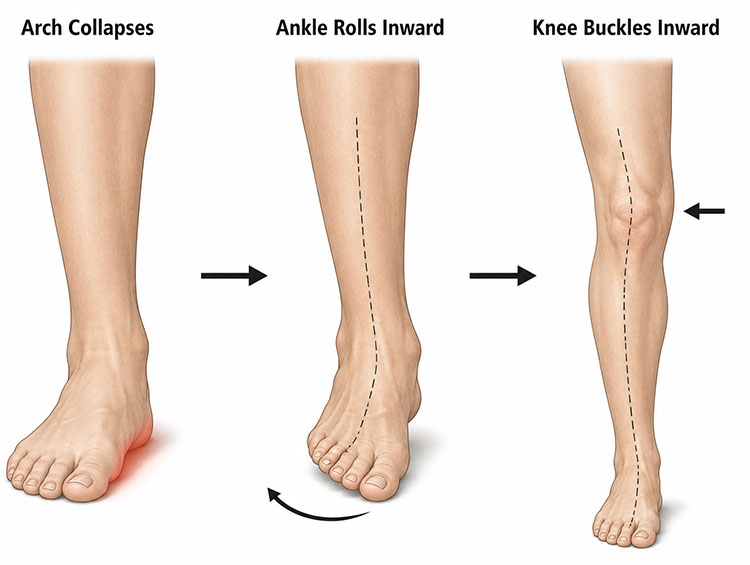
In Simple Terms: If the arch on the inside of your foot collapses, your ankle rolls inward. This twist travels up your leg, forcing your knee to turn inward and your hip to tilt. This chain reaction can make your lower back ache.
4. Massage Therapy and Foot Mechanics
Under British Columbia’s RMT regulations, treatment must focus on evidence-informed outcomes, such as reducing muscle hypertonicity and managing discomfort. When the foot tripod is unbalanced, the Center of Pressure shifts, distorting the Ground Reaction Force vector and forcing the muscles up the kinetic chain to contract chronically to maintain equilibrium, which can lead to postural compensations, myofascial strain, and localized pain.
Using registered massage therapy to treat the intrinsic foot muscles, the plantar fascia, and the calf muscles can help restore normal tissue extensibility.Your therapist can also provide home care exercises, such as foot-strengthening drills, to help you maintain a stable tripod
In Simple Terms: Your therapist can work on your feet and calves. By loosening the tight tissues under your foot and in your lower leg, this can help your foot tripod spread out and grip the floor more evenly.
5. Neuromuscular Relaxation and Proprioception
Maintaining a stable foot tripod requires excellent proprioception, your brain’s ability to sense where your body is in space. The sole of the foot is packed with mechanoreceptors that feed this information to your brain.
When you experience chronic pain, these sensory signals can become distorted, leading to poor balance and increased muscle guarding. A registered massage therapist can use specific manual techniques to stimulate these sensory receptors, helping to reset the neural pathway between your feet and your brain.
This process encourages systemic relaxation, which calms the nervous system and reduces protective muscle tension. When your body is in a state of relaxation, it becomes much easier to adopt a neutral, balanced posture. A registered massage therapist can help you achieve this state, providing both immediate symptom relief and long-term postural support through targeted massage.
In Simple Terms: The bottom of your foot is like a high-tech sensor pad that tells your brain how to balance.
Summary: The Stable Foundation
Your posture is a dynamic reflection of how your body manages force, and that management begins at the foot tripod. When your heel, big toe, and pinky toe are evenly balanced, your body can distribute the Ground Reaction Force cleanly through your joints, protecting you from pain.
If you are struggling with postural fatigue, a registered massage therapist can be an invaluable partner in your recovery. A massage therapist can help you address the muscular imbalances that pull your foundation out of alignment.
Ultimately, working with a registered massage therapist to restore foot and lower leg mobility is a practical, evidence-informed way to manage pain. By supporting your muscles and connective tissues, a professional massage helps you build a stable, comfortable foundation.