Posture & Biomechanics
Part 1: Forward Head Posture (FHP) and Ground Reaction Force (GRF)
Forward Head Posture (FHP), characterized by the anterior translation of the cervical spine, lower cervical flexion, and upper cervical extension, is one…
Forward Head Posture (FHP), characterized by the anterior translation of the cervical spine, lower cervical flexion, and upper cervical extension, is one of the most common sagittal plane postural deviations in modern society (Ruivo et al., 2014). While FHP is often evaluated as an isolated cervical spine issue, biomechanical principles dictate that any localized shift in mass alters the body’s global relationship with the Ground Reaction Force (GRF).
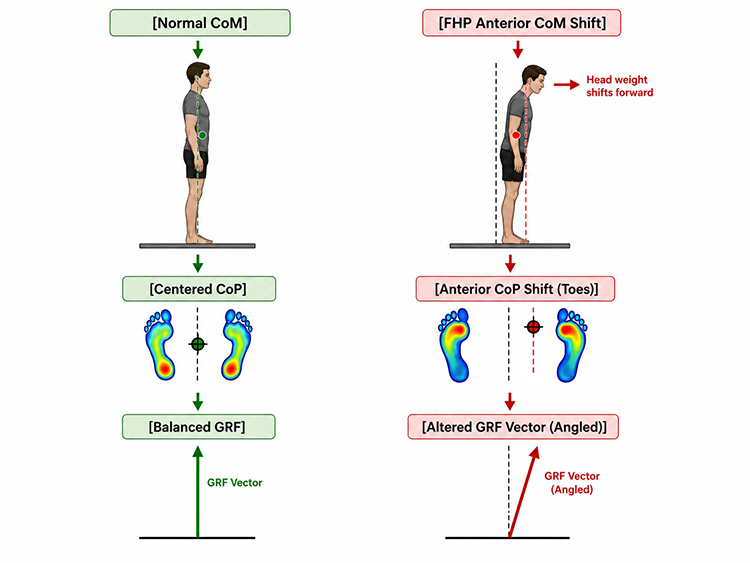
1. The Center of Mass (CoM) Displacement
The human head accounts for approximately 8% to 10% of total body weight. According to Kendall et al. (2005), in an optimal postural alignment, the Line of Gravity (LoG) passes directly through the external auditory meatus, the acromion process, and slightly posterior to the hip joint axis.
When the head translates anteriorly:
The body’s overall Center of Mass (CoM) shifts anteriorly.
This displacement increases the horizontal distance (moment arm) between the head’s center of mass and the cervicothoracic junction (C7-T1).
According to Kapandji (Physiology of the Joints, Volume 3), for every inch of anterior translation, the effective load of the head on the cervical spine increases by approximately 10 pounds due to the increased external flexor moment.
2. The Center of Pressure (CoP) and GRF Realignment
To prevent the anteriorly displaced CoM from falling outside the base of support (which would cause a forward fall), the central nervous system must execute a compensatory strategy (Winter, 2009).
The nervous system shifts the Center of Pressure (CoP) anteriorly toward the metatarsal heads and toes.
This anterior CoP shift alters the orientation and point of application of the GRF vector, tilting it slightly backward to generate a counteractive posterior moment.
Consequently, the GRF vector now passes further anterior to the ankle joint axis, creating a chronic, elevated external dorsiflexion moment (Nordin & Frankel, 2001).
3. Kinetic Chain Compensations
To balance this altered GRF vector, the body recruits a chain of muscular and structural compensations:
The Ankle/Calf: The gastrocnemius and soleus must contract eccentrically to resist the increased external dorsiflexion moment.
The Pelvis/Hip: To counteract the anterior weight shift, the pelvis often translates posteriorly (hip extension or anterior pelvic tilt) to keep the global CoM over the midfoot (Levangie & Norkin, 2011).
The Cervicothoracic Spine: The deep cervical flexors (longus colli, longus capitis) become lengthened and inhibited, while the cervical extensors (splenius capitis, upper trapezius, levator scapulae) must contract chronically to prevent the head from collapsing into flexion.