Posture & Biomechanics
Part Two: How Forward Head Posture Alters Your Ground Reaction Force
The Domino Effect: How Forward Head Posture Alters Your Ground Reaction Force If you sit at a desk or look down at a phone for hours, you might be familiar…
The Domino Effect: How Forward Head Posture Alters Your Ground Reaction Force
If you sit at a desk or look down at a phone for hours, you might be familiar with Forward Head Posture (FHP). While it seems like a local neck issue, FHP actually alters how your entire body interacts with the earth. If you are seeking care at a Burnaby massage clinic, a therapist can help you address the muscular strain associated with this condition. Understanding how FHP alters your Ground Reaction Force (GRF) is a key step in managing postural pain.
In Simple Terms: Standing up isn’t just resting; it’s an active workout for your nervous system. When your body fights gravity inefficiently, your muscles can get exhausted and sore. Getting a professional massage helps soothe these tired muscles, bringing back a sense of ease and relaxation.
1. What is Forward Head Posture (FHP)?
Forward Head Posture occurs when your head shifts forward in front of your shoulders, rather than sitting directly above them. This anterior shift changes the mechanical load on your spine.
When your neck alignment is altered, a therapist can assess the affected soft tissues. This structural change often leads to chronic neck pain and tension.
In Simple Terms: Imagine holding a bowling ball close to your chest versus holding it out at arm’s length. The further forward it goes, the heavier it feels. When your head slumps forward, your neck muscles have to work incredibly hard to stop your head from falling off, which causes pain. Massage can help soothe these overworked muscles.
2. The Domino Effect: How FHP Alters Your Ground Reaction Force
According to biomechanical principles, shifting the head forward moves the body’s overall Center of Mass (CoM) anteriorly. To prevent a forward fall, the nervous system must shift the Center of Pressure (CoP) forward toward the toes. This alters the GRF vector, creating a continuous, stressful load on the posterior chain.
If you consult a massage therapist, they can help identify how this shift contributes to lower back and hamstring tightness. Utilizing massage therapy is an excellent way to address these widespread compensations.
In Simple Terms: When your head leans forward, your whole body weight tilts forward too. To keep you from tipping over, your feet have to press harder into the ground near your toes. This changes how the ground pushes back up against you, putting extra stress on your calves, hamstrings, and back, which often leads to muscular pain. A massage can help relieve this tension.
3. The Joint Moment Toll: From Ankles to Neck
Because the GRF vector is now positioned further anterior to the ankle joint, it generates an increased external dorsiflexion moment (a force trying to tilt your shins forward). This chronic demand on the calves can cause persistent discomfort.
A registered massage therapist can perform targeted manual therapy to address this tightness. Furthermore, the increased moment arm at the neck forces the cervical extensors to contract chronically, causing pain. A qualified therapist can help manage this discomfort.
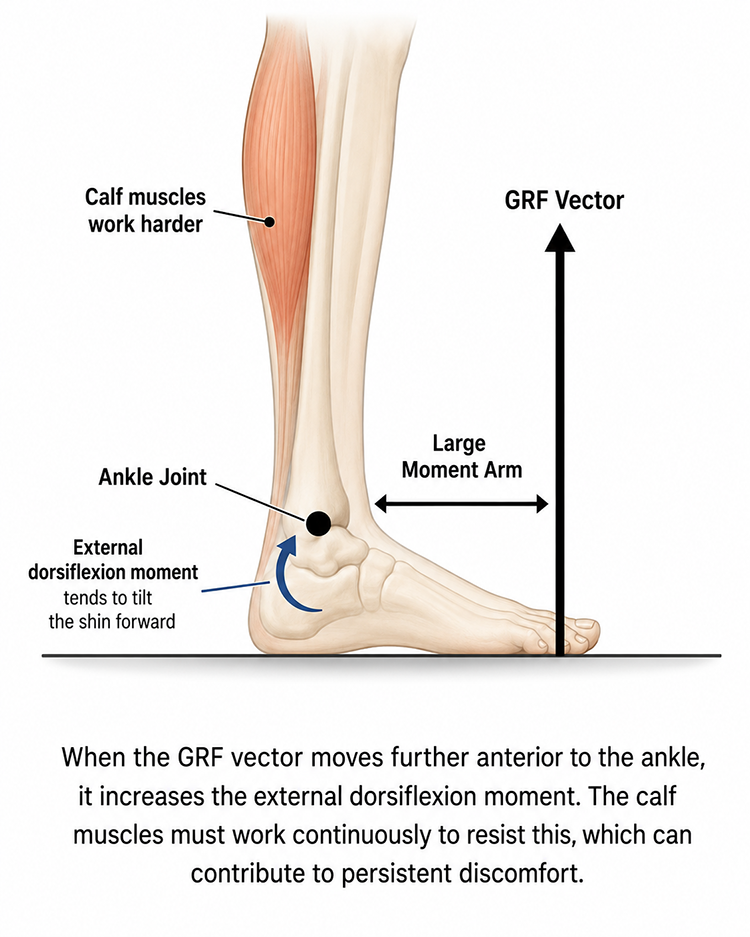
In Simple Terms: Because your body is tilting forward, your calf muscles and neck muscles are locked in a permanent game of tug-of-war to keep you upright. This constant pulling makes them tight and sore. A qualified therapist knows exactly which “ropes” are pulled too tight and can help loosen them through massage.
4. Evidence-Informed Care for FHP
Under British Columbia’s RMT regulations, treatment must focus on evidence-informed outcomes, such as reducing muscle tension, improving joint range of motion, and managing pain. A registered massage therapist does not “cure” posture, but rather helps manage the soft tissue symptoms associated with postural dysfunction. By incorporating registered massage therapy into your routine, you can support your body’s natural ability to recover from chronic strain.
This clinical massage therapy is designed to decrease nociceptive input (pain signals) and promote tissue extensibility. When you work with a registered massage therapist, they can also provide home care exercises to help you maintain these improvements.
5. The Importance of Neuromuscular Relaxation
Managing FHP is not just about physical stretching; it also requires calming the nervous system. When the body is in chronic pain, the sympathetic nervous system (fight-or-flight) is highly active, keeping muscles tense. A registered massage therapist can use specific techniques to encourage parasympathetic nervous system activity, facilitating deep relaxation.
This systemic relaxation helps reduce the protective guarding response in the neck and shoulders. When your muscles are allowed to rest, it becomes much easier to retrain your posture. Your therapist can help identify these tension patterns and guide you through this process.
In Simple Terms: When you are sore and stressed, your body stays on high alert, which makes your muscles tighten up even more.
Summary: The Postural Symphony
Posture is not a fixed shape; it is a dynamic force-management system. When your head shifts forward, the ground’s upward push is bent, forcing your entire body to compensate. Therapy can help you manage the muscular tension associated with these shifts, keeping you free from postural pain. By incorporating a massage into your routine, you can experience the benefits of registered massage therapy as they extend throughout your entire kinetic chain. Visiting a registered massage therapist is a proactive step toward helping your body move with greater ease and efficiency.