Posture & Biomechanics
The Ground Reaction Force (GRF) and Posture
To understand posture, we must first abandon the idea that standing is a passive state. Biomechanically, standing is a highly active, continuous…
To understand posture, we must first abandon the idea that standing is a passive state. Biomechanically, standing is a highly active, continuous negotiation with the physical universe. At the center of this negotiation is the Ground Reaction Force (GRF).
Without GRF, we could not stand, walk, or even maintain a seated position. It is the literal foundation of human biomechanics. When our bodies struggle to adapt to these forces efficiently, it can contribute to chronic muscle tension, stiffness, and joint pain. This is why many individuals utilize registered massage therapy as part of their physical rehabilitation or maintenance plans. If you are looking for evidence-informed care at a burnaby massage clinic, understanding how your body manages these forces can help you collaborate more effectively with your registered massage therapist to achieve symptom relief and promote muscular relaxation.
In Simple Terms: Standing up isn’t just resting; it’s an active workout for your nervous system. When your body fights gravity inefficiently, your muscles can get exhausted and sore. Getting a professional massage helps soothe these tired muscles, bringing back a sense of ease and relaxation.
1. What is the Ground Reaction Force (GRF)?
The Ground Reaction Force is a direct application of Newton’s Third Law of Motion: For every action, there is an equal and opposite reaction.
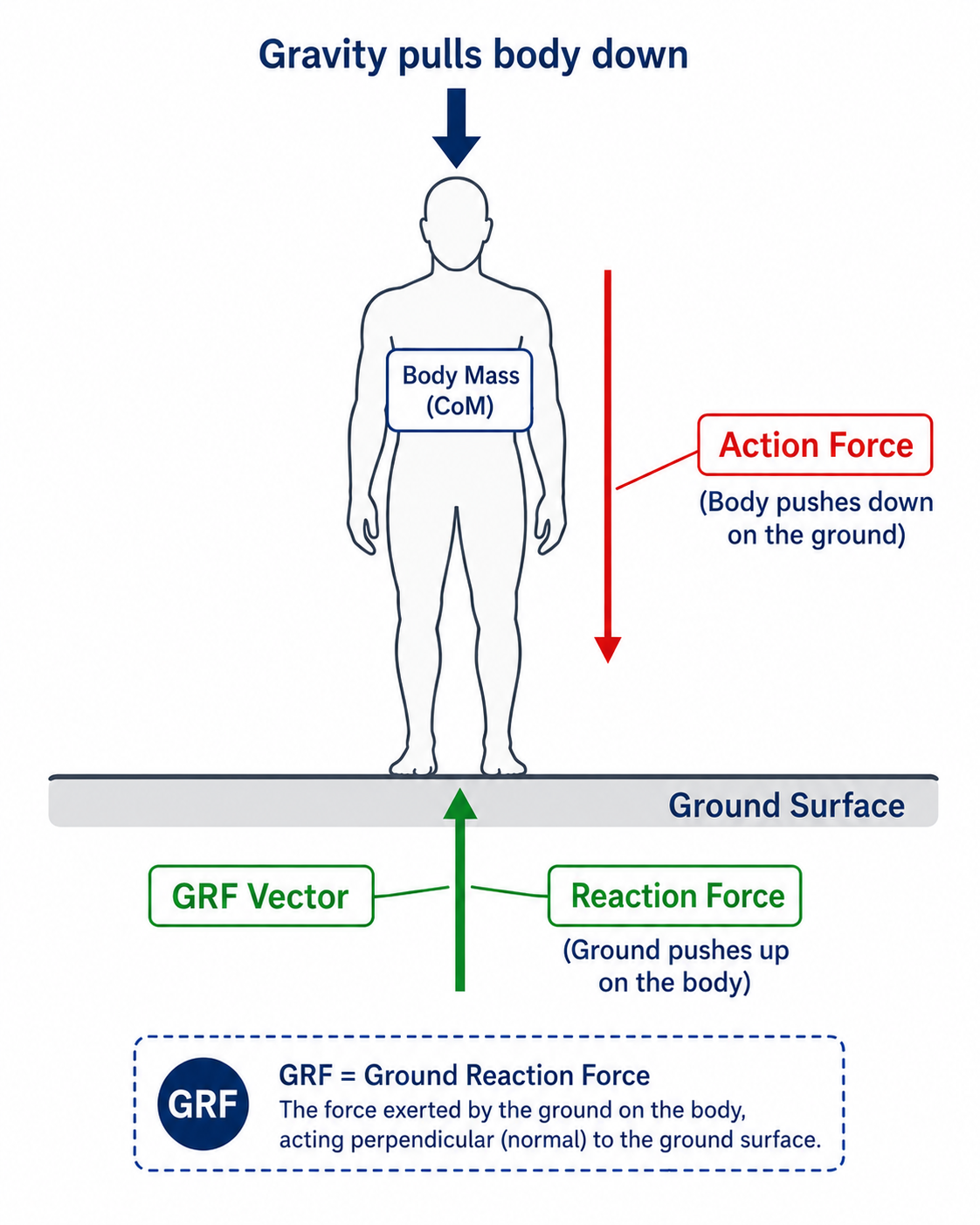
When you stand, your body mass is acted upon by gravity, creating downward force (your weight) against the Earth. Because you do not sink into the floor, the ground must push back against your feet with a force of equal magnitude and opposite direction. This upward-pushing force is the Ground Reaction Force.
The Anatomy of the GRF Vector
The GRF is not a vague, generalized pressure; it is a highly specific vector defined by three distinct properties:
- Magnitude: How hard the ground is pushing. In quiet standing, the vertical magnitude of the GRF is exactly equal to your body weight (1.0×1.0×BW).
- Direction: The angle at which the force enters the body. While primarily vertical during standing, it tilts to counteract body sway.
- Point of Application: The exact location on the sole of the foot where this force enters. This point is the Center of Pressure (CoP).
When these forces are misaligned, your muscles may work harder to keep you upright, which can lead to localized discomfort or pain. A massage therapist can assess these patterns of muscle tension to help address the soft tissues under constant load.
In Simple Terms: Imagine stepping on a bathroom scale. Your body weight pushes down on the scale, and the scale pushes back up with the exact same power to measure your weight. The ground does this same thing every time you stand on it. That upward push from the floor is the “Ground Reaction Force.” It enters your body through one specific plug-like spot under your foot, which is your “Center of Pressure.” When this force enters at an inefficient angle, it can strain your muscles and contribute to pain, which is why clinical massage can be a helpful tool for managing musculoskeletal discomfort.
2. The Postural Equation: GRF vs. Gravity
Static postural equilibrium is a state of balance between two primary, opposing force vectors:
| Force Vector | Origin Point | Direction | Biomechanical Role |
|---|---|---|---|
| Line of Gravity (LoG) | Center of Mass (CoM) | Downward | The “Action” pulling the body to the earth. |
| Ground Reaction Force (GRF) | Center of Pressure (CoP) | Upward | The “Reaction” supporting and stabilizing the body. |
The Rule of Collinearity
For the body to be in perfect static equilibrium, the LoG and the GRF vector must be collinear (aligned on the exact same vertical line) and opposite.
If your Center of Mass (CoM) shifts forward, the LoG moves forward. If the GRF vector does not also shift forward to match it, a rotational force (torque) is created, and you will fall forward.
When this subconscious alignment is thrown off, it can result in persistent muscle tension and chronic postural pain. A registered massage therapist can help identify areas of soft tissue restriction associated with these patterns. To prevent this, the nervous system instantly fires the calf muscles, shifting the Center of Pressure (CoP) forward. This realigns the GRF vector directly beneath the new CoM, restoring equilibrium. Posture, therefore, is the continuous, subconscious alignment of the GRF vector with the Line of Gravity.
In Simple Terms: Think of balancing a broomstick upright on the palm of your hand. If the heavy top of the broom tilts forward, you have to quickly slide your hand forward to keep it from crashing down. Your feet do this exact same “hand-sliding” dance on the floor all day long. They constantly adjust where they push against the ground to stay directly underneath your shifting body weight. Incorporating registered massage therapy can help address this muscle tension, supporting overall comfort.
3. The Joint Moment Matrix: How GRF Shapes Segmental Posture
Because the human skeleton is a chain of segments connected by hinges (joints), the path the GRF vector takes through the body determines which muscles must work to keep us upright.
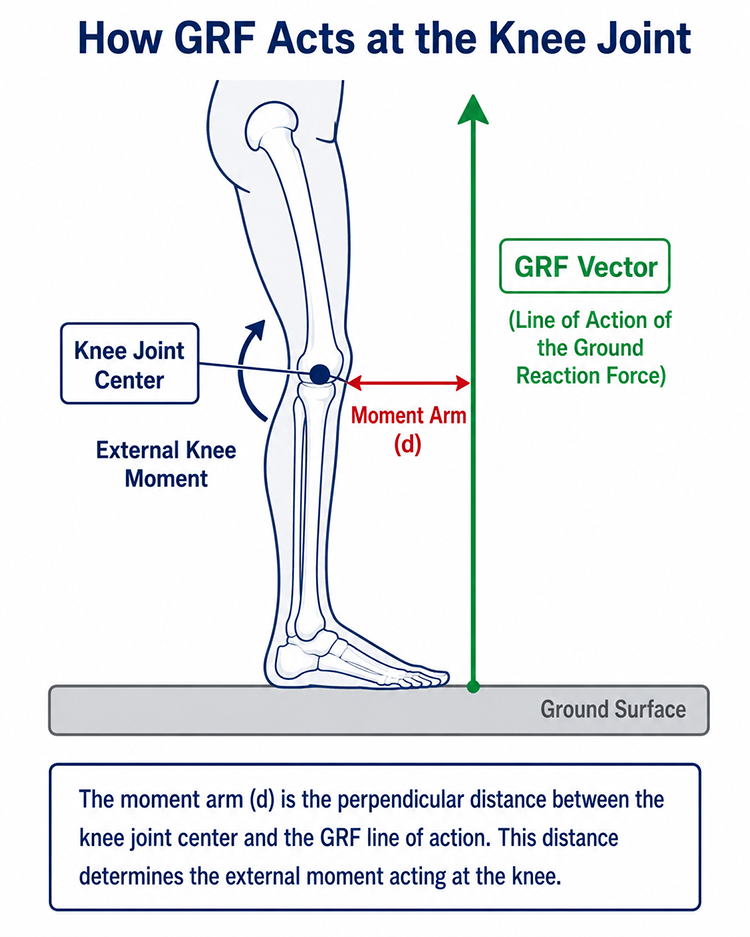
When the GRF vector does not pass directly through a joint’s axis of rotation, it creates an External Joint Moment (Torque). The formula for this torque is:
=×Moment=Force (GRF)×Moment Arm (Distance from joint center)
To prevent the joint from collapsing under this external torque, the nervous system must generate an equal and opposite Internal Joint Moment via muscle contraction or passive ligamentous tension.
A. The Ankle Joint
- GRF Path: Passes slightly anterior (in front of) the lateral malleolus (ankle joint axis).
- External Moment: Because the GRF passes in front of the ankle, it creates an external dorsiflexion moment (tipping the shin bone forward).
- Internal Correction: The Soleus and Gastrocnemius (calf muscles) must contract continuously to pull the shin bone back. This is why the calves are the most active muscles during quiet standing. This constant load can cause calf tightness and localized pain. A registered massage therapist can use manual therapy techniques to help reduce tension in the lower leg.
B. The Knee Joint
- GRF Path: Passes slightly anterior to the knee joint axis (just in front of the kneecap).
- External Moment: This anterior pathway creates an external extension moment, pushing the knee into extension.
- Internal Correction: Because the knee is pushed into extension, it naturally “locks” against its posterior capsule and ligaments. This is an energy-saving mechanism: the GRF holds the knee straight, allowing the quadriceps to remain completely relaxed during quiet standing.
C. The Hip Joint
- GRF Path: Passes slightly posterior to the hip joint axis (through the greater trochanter).
- External Moment: This posterior pathway creates an external extension moment, tilting the pelvis backward.
- Internal Correction: This extension moment is resisted passively by the extremely strong iliofemoral (“Y”) ligament on the front of the hip. If restrictions develop here, a registered massage therapist can focus on these regions to help improve joint mobility.
D. The Vertebral Column
- GRF Path: Passes through the physiological curves of the spine (anterior to the thoracic spine, posterior to the lumbar and cervical spine).
- External Moment: Tries to exaggerate the natural curves (flexing the thoracic spine, extending the lumbar spine).
- Internal Correction: Resisted dynamically by the erector spinae muscles and passively by the spinal ligaments. For the spine, a registered massage therapist can provide targeted soft tissue treatment to help manage back discomfort.
In Simple Terms: Imagine your joints are hinges on a door. If you push directly on the hinge, the door doesn’t move. But if you push on the handle (away from the hinge), the door swings open easily. When the ground’s upward push doesn’t line up perfectly with your ankle, knee, or hip joints, it acts like a hand pushing a door handle—it tries to bend your joints. Your muscles have to act like tight ropes to pull those joints back into place so you don’t collapse. A massage therapist can identify which muscle groups are working overtime and help decrease their tension through a targeted massage.
4. Posture as a Dynamic Dance: Sway and Sensorimotor Control
We often think of posture as a static pose, but under a force plate, we see that standing is actually a continuous, highly controlled sway. This is called the postural sway envelope.
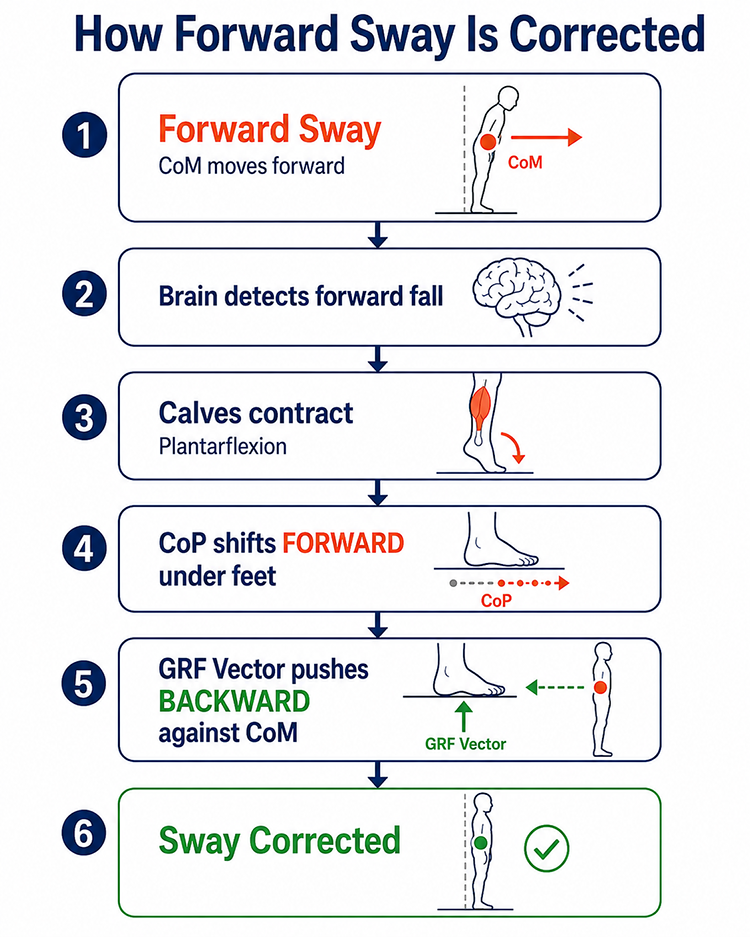
- The Drift: As you stand, your CoM slowly drifts forward due to breathing, heartbeat, and gravity.
- The Detection: Mechanoreceptors in the soles of your feet (detecting CoP shifts) and proprioceptors in your calves detect this forward drift.
- The Correction: The brain sends a signal to the soleus muscle to contract. This contraction pushes the toes into the ground, shifting the CoP forward.
- The Result: Shifting the CoP forward moves the GRF vector anteriorly, creating a backward-acting torque that pushes your CoM back to the center.
Because the postural sway is continuous, your muscles never truly rest while standing. This constant activity can cause micro-fatigue, which may present as a dull ache or pain. To help manage this neuromuscular fatigue, a registered massage therapist can utilize techniques that support muscle recovery.
Without this constant adjustment of the GRF vector via the CoP, you would tip over within seconds. Posture is the art of keeping the GRF vector dynamically dancing around your Center of Mass.
In Simple Terms: You are never actually standing completely still. Instead, you are constantly falling forward by a fraction of an inch, catching yourself, and pulling yourself back. It is like an invisible, continuous game of tug-of-war happening between your brain and your calf muscles every single second just to keep you upright. Getting a therapeutic massage can help soothe these tired muscles, allowing your body to rest.
5. The Biotensegrity Perspective: Posture Beyond Levers
While the traditional “kinetic chain” model treats the skeleton as a stack of bones acting as levers against the GRF, the biotensegrity model offers a more integrated explanation.
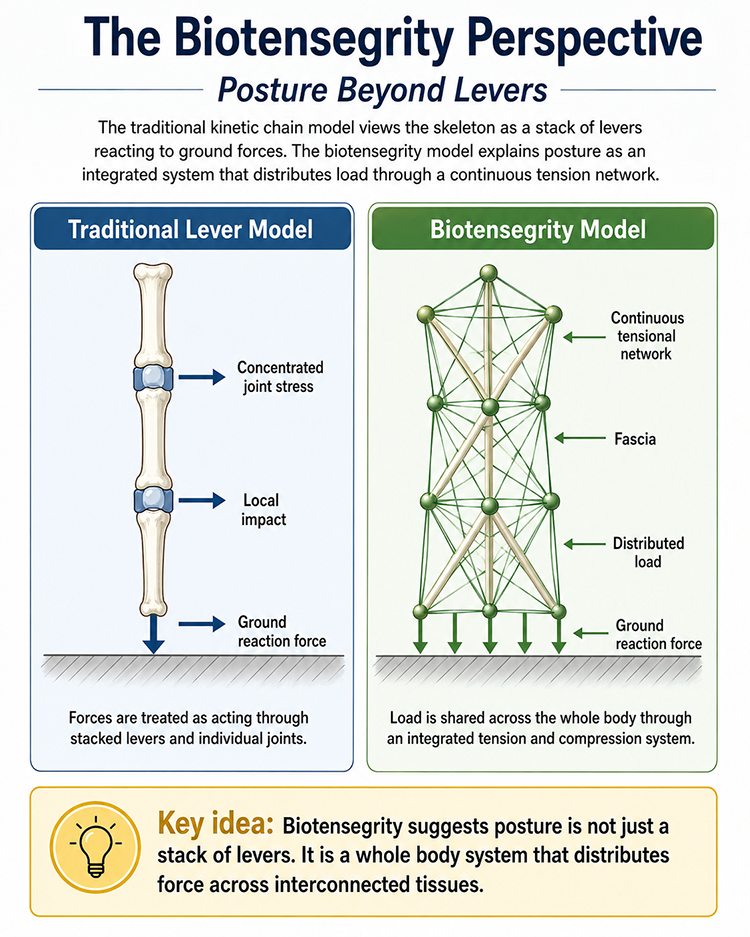
In a biotensegrity system, the body is a continuous tensional network (fascia, muscles, tendons) containing discontinuous compression struts (bones).
- Global Distribution: When the GRF enters the foot at the CoP, it is not merely pushed up from bone to bone. Instead, the force is converted into a tension wave that travels through the connected fascial web (such as the Superficial Back Line, which links the plantar fascia, Achilles tendon, hamstrings, sacrotuberous ligament, and erector spinae).
- Pre-Stress (Tensegrity): Optimal posture is the state of balanced pre-stress (tonus) in this fascial network. When the network is balanced, the incoming GRF is distributed more globally throughout the entire body, minimizing localized stress on any single joint. If one part of the network is restricted, the GRF cannot be distributed evenly, leading to localized joint strain and postural compensations elsewhere.
In a biotensegrity system, the entire fascial web is connected. While biotensegrity is primarily a conceptual model for force distribution, it helps explain why a restriction in one area, like the foot, might correlate with postural pain elsewhere. A registered massage therapist often takes this broad perspective into account, using registered massage therapy to address myofascial tension throughout the kinetic chain. This whole-body approach to massage helps support overall physical ease.
In Simple Terms: Instead of thinking of your body as a stack of heavy wooden blocks, picture it as a camping tent. The tent poles (your bones) don’t actually touch each other; they are held up by the tension of the tent’s fabric and ropes (your muscles and connective tissues). When the ground pushes up against your feet, that force doesn’t just bump straight up your leg bone—it spreads out through the entire “fabric” of your body, all the way from your toes to your head. A registered massage therapist can help identify and address these tension patterns through massage.
6. Pathological Posture: When the GRF Vector Goes Rogue
When postural alignment is compromised, the GRF vector becomes a source of mechanical strain rather than a stabilizing force.
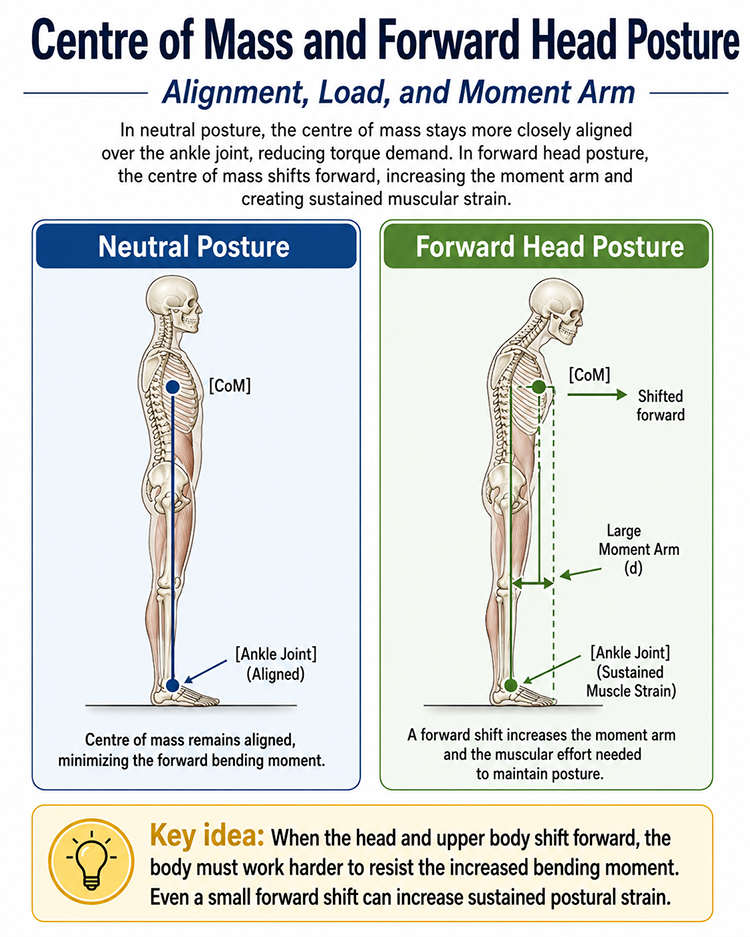
A. Forward Head and Kyphotic Posture
When the head and upper thoracic spine slump forward, the body’s overall CoM shifts anteriorly.
- The GRF Consequence: To prevent falling forward, the CoP must remain chronically shifted toward the toes. This places the GRF vector far anterior to the ankle joint, creating a massive, sustained external dorsiflexion moment.
- The Cost: The calves, hamstrings, and erector spinae must contract chronically to hold the body up. This chronic tension is a common contributor to upper body tension and postural pain. A massage therapist can work with you to release tight anterior structures and help improve your postural awareness.
B. Flat Foot (Excessive Pronation)
If the medial longitudinal arch of the foot collapses, the foot tripod is compromised.
- The GRF Consequence: The CoP shifts medially. The GRF vector no longer travels up the lateral side of the leg but shoots up the medial side of the knee.
- The Cost: This medial GRF pathway creates an external valgus moment at the knee (knocking the knee inward). This strains the medial collateral ligament (MCL), stresses the patellofemoral joint, and forces the hip into internal rotation, leading to a cascade of postural misalignments up to the pelvis and lower back. A registered massage therapist can target the affected muscles of the lower leg and hip to help manage these compensatory patterns.
In Simple Terms: When you slouch, lean your head forward, or stand with flat feet, you bend the angle of the ground’s upward push. Instead of the force traveling safely up through your strong bones, it starts pushing sideways against your joints. This is like trying to hold a heavy bowling ball with a fully outstretched arm instead of keeping it close to your chest—your muscles quickly get exhausted, and your joints start to wear down. Regular massage is incredibly helpful here because it relieves the intense strain on those overworked muscles.
7. The Role of Massage in Postural Recovery and Pain Relief
While understanding the physics of GRF is essential, we must also have practical, evidence-informed tools to manage musculoskeletal imbalances. This is where massage therapy plays an important role within a multidisciplinary healthcare approach. When muscles are subjected to chronic, abnormal loads due to a misaligned GRF vector, they develop protective tension. This tension can lead to persistent pain and restricted joint range of motion, prompting many to consult a registered massage therapist.
By utilizing manual therapy, a registered massage therapist can help reduce muscle hypertonicity, improve soft tissue extensibility, and support local circulation. A skilled massage therapist can help guide this process by offering tailored home care, such as stretching and strengthening exercises, to reinforce postural alignment.
Furthermore, receiving a regular massage can help improve proprioception—your brain’s awareness of your body’s position in space. With better sensory feedback from the feet and joints, the nervous system can make more precise adjustments to the Center of Pressure (CoP). Ultimately, working with a registered massage therapist is a clinically recognized way to manage the physical forces acting on your body, reduce chronic discomfort, and support functional mobility.
In Simple Terms: Think of your muscles like rubber bands that have been pulled too tight for too long. If you don’t let them relax, they will eventually stretch out or snap, causing discomfort. A professional massage acts like a helping hand that gently coaxes these tight rubber bands to loosen up.
Summary: The Postural Symphony
Posture is not a fixed shape; it is a dynamic force-management system.
The Ground Reaction Force (GRF) is the raw energy provided by the Earth. Your Center of Pressure (CoP) is the steering wheel, and your Center of Mass (CoM) is the cargo that must be balanced.
Optimal posture is the state of perfect harmony where the nervous system uses the CoP to steer the GRF vector so cleanly through the body’s joints and biotensegrity pathways that the downward pull of gravity is effortlessly neutralized, leaving the body in a state of poised, efficient, and pain-free readiness.