Posture & Biomechanics
The Aware Body: How Subtle Attention Reshapes Your Relationship with Gravity
We often tend to think of posture as something we do—a position we hold through effort and a certain quiet determination. We square our shoulders, lengthen…
We often tend to think of posture as something we do—a position we hold through effort and a certain quiet determination. We square our shoulders, lengthen the back of the neck, and gently gather ourselves upright, sometimes with a steadiness that can leave us a little weary before long. We may treat “standing tall” as an instruction to follow through muscular work, and when the tiredness arrives, we sometimes assume we simply need to apply ourselves a touch more.
But the body may operate rather differently. Some of the most efficient posture seems less like something we impose and more like something the body settles into when it is offered a little more information. The human frame is a remarkably organized structure, often capable of supporting itself against gravity with surprising economy—particularly when it is allowed to align around the physical forces moving through it. And the key to that alignment may be less about effort and more about attention. By gently noticing the forces already present within us—especially the ongoing interaction between gravity and the Ground Reaction Force (GRF)—we may find that the skeleton begins, in its own time, to settle toward greater ease.
This isn’t an abstract notion. It seems to rest, at least in part, on the straightforward neurophysiology of how the brain takes in sensory information and gradually shapes it into balance. Let us work through, step by step, how the simple act of noticing might begin to change the way we stand, move, and organize ourselves within our own frame.
1. The Force We Rarely Notice
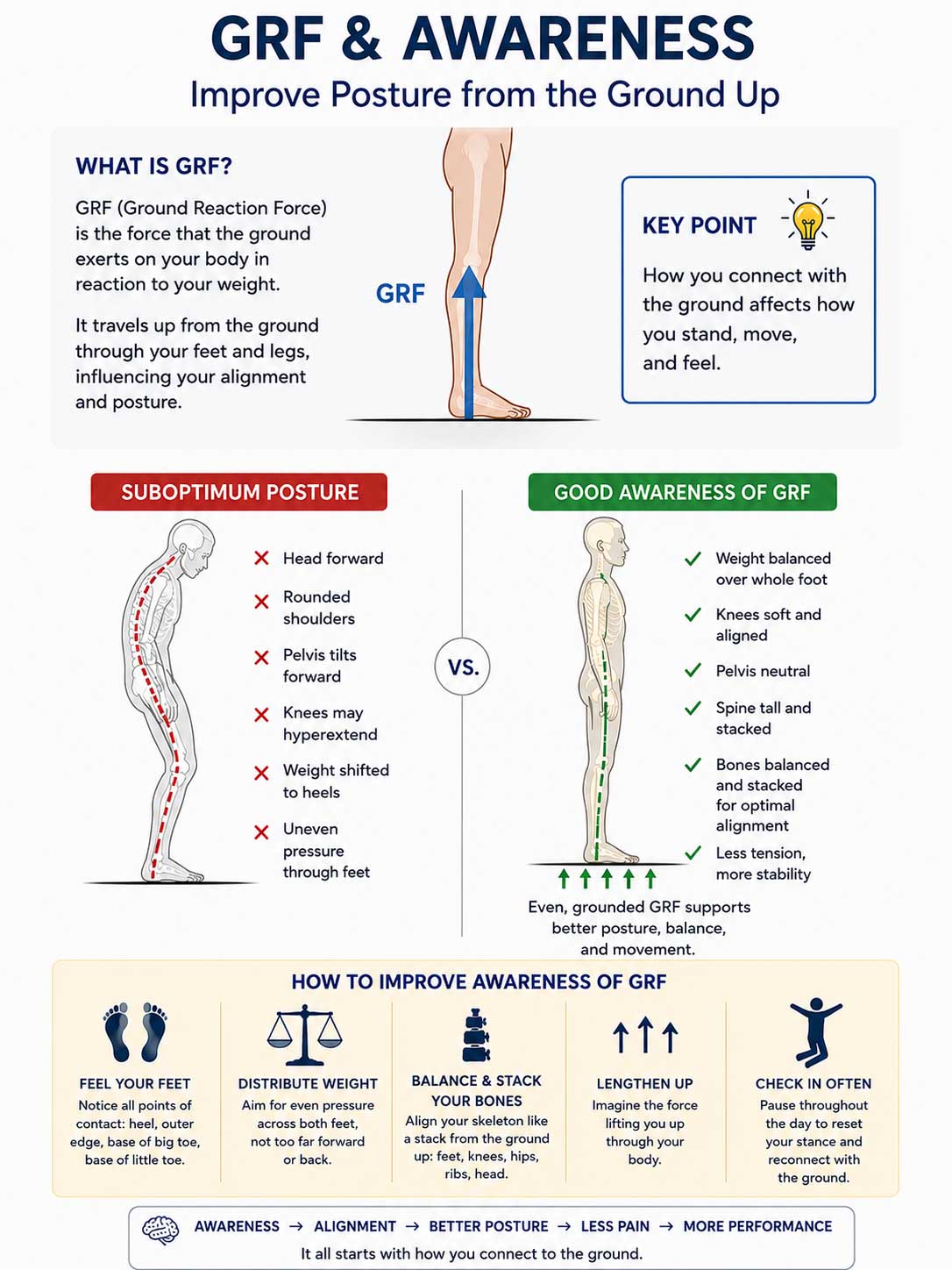
The Ground Reaction Force (GRF) is the upward force the earth exerts on the body in response to our weight, in keeping with Newton’s Third Law of Motion: for every action, there tends to be an equal and opposite reaction. As the body presses its weight down into the floor, the floor meets that weight with a force of roughly equal magnitude, pushing back up to support us.
In quiet standing, the primary component of this force is largely vertical, traveling up through the feet, the lower limbs, the pelvis, the spine, and onward toward the head, helping to counteract the downward pull of gravity on our Center of Mass (CoM)—the theoretical point, often located near the second sacral vertebra, where much of the body’s mass is concentrated.
This force is present in nearly every moment, and yet it tends to operate beneath the surface of our attention. We may feel its result—the sensation of pressure under the feet, the firmness of the ground—without quite registering it as a supportive partner in the work of standing. And this can be an easy thing to overlook. When we don’t account for this upward support, we sometimes tend to override it. We brace, we hold, we gather ourselves up with more muscular effort than the moment truly requires, working against gravity somewhat in isolation rather than allowing the upward support the ground provides to do its share. It can be a little like someone treading water who hasn’t yet realized they are standing in a shallow pool.
In Simple Terms: Right now, the floor is pushing up against your feet with about the same force as your body weight. You may never have noticed it. We spend much of our lives standing on this upward support from the earth without ever really feeling it there. We sometimes assume that holding ourselves up is entirely our own job—a task for our tired muscles—when in fact, the ground carries a good deal of the work for us. Recognizing this steady support can be a small but useful shift.
2. Attention as a Biomechanical Tool
The soles of our feet are densely supplied with mechanoreceptors—sensory cells, among them Merkel discs, Pacinian corpuscles, Ruffini endings, and Meissner corpuscles, that respond to pressure, vibration, stretch, and the changing distribution of weight. These receptors provide the brain with a steady stream of information about the location of the Center of Pressure (CoP), the point through which the GRF enters the body.
The act of paying attention doesn’t change the underlying physics—gravity still draws us down, and the ground still rises to meet us. But it can shift the processing of that information. Attention appears to influence how sensory signals are weighted and prioritized within the nervous system. When we direct awareness to the soles of the feet, the proprioceptive signal reaching the brain may become a little clearer and more present. And with somewhat clearer information, the nervous system often appears to make smaller, more refined adjustments to the position of the CoP.
In effect, attention may raise the working “resolution” of our balance system. Rather than relying on the larger, slower, more costly corrections—the kind that tend to occur when we are moving through the day on autopilot, distracted by other things—the brain seems freer to make tiny, continuous, anticipatory refinements. What tends to emerge is a smoother, quieter, and generally more economical way of standing.
In Simple Terms: The bottoms of your feet are covered with countless small pressure sensors that constantly report to your brain about how your weight is distributed. But rather like a phone notification you’ve learned to glance past without really seeing, your brain often tunes these signals out, especially when you’re distracted or thinking about something else. When you simply notice the feeling of your feet on the floor, you turn the volume back up on these sensors. With clearer information, your brain may begin to balance you with small, refined adjustments rather than larger, more tiring ones.
3. The Difference Between Holding and Allowing
There can be a meaningful distinction in motor control between an imposed posture and an organized one. From the outside they may look rather similar, yet within the body they often represent two quite different strategies, with noticeably different costs.
The Imposed Posture (More Effort): When we consciously “hold” ourselves upright through will, we tend to recruit the larger muscles—the erector spinae, the upper trapezius, the abdominals—into sustained contraction. This approach is relatively costly in energy and tends to generate a fair amount of muscular activity. It can restrict the breath, load the joints somewhat unevenly, and lead toward fatigue over time. And often, in this mode, the GRF vector sits a little out of line with the joints, working against the effort rather than easing it.
The Organized Posture (Less Effort): When the Center of Mass comes to rest more comfortably over the Center of Pressure, the GRF vector tends to travel more cleanly through the centers of the major joints—the ankle, the knee, the hip, and the curves of the spine. In this arrangement, the bones and ligaments are able to take on more of the load, and the postural muscles may only need to provide a quiet, low-level tone, much like a hand resting lightly on a tiller.
Attention can act as a bridge between these two states. Rather than instructing the body precisely where it ought to be, we might simply note where the forces seem to settle—and allow the nervous system to reorganize, in its own time and at its own pace, toward something more efficient.
In Simple Terms: There seem to be two ways to stand. The first is to “hold” yourself fairly rigid, like standing at attention—it works well enough, but it tends to tire you. The second is to gently “allow” yourself to be supported, letting your bones settle so that the ground’s upward push can carry some of the weight. A little attention can help the body shift, gradually, from the first way toward the second.
4. A Quiet Exercise in Force Awareness
You don’t need to force anything here. You can simply observe for a little while. If you’d like, you could try this gently, without any particular goal in mind:
Arrive at the Feet: Stand comfortably. Without changing anything, let your attention move down to where your feet meet the floor. You might note the areas of greater and lesser pressure, the warmth, the texture beneath you.
Note the Upward Support: Recognize that the floor is meeting your feet with an upward force. Rather than pressing down, you might allow yourself to feel supported by the ground. You may notice the spine lengthening a little on its own, without your directing it to.
Let the Weight Settle: Bring your awareness to your lower pelvis—the region of your Center of Mass. Without placing it anywhere in particular, you might simply let your weight settle down through the skeleton, the way sediment drifts toward the bottom of still water.
Note What Eases: As things settle, you may sense a small release somewhere—perhaps in the calves, the lower back, the shoulders, or the neck. It tends to arrive on its own, rather than through any effort of yours.
In Simple Terms: Stand still for a moment and simply notice your feet on the floor. Recognize that the ground is supporting you, pushing up to hold you. Let your weight settle down into that support. You may find that something softens here or there—not because you made it happen, but because the body found a little more ease on its own, once it had a chance to register the support.
5. Carrying the Awareness Into Movement
What begins in quiet standing need not stay there. The same relationship between gravity, the Center of Mass, and the Ground Reaction Force unfolds continuously as we move—as we walk, reach, bend, or rise from a chair. In gait, the GRF is far from static; it ebbs and flows through braking and propulsive phases, and its line of action shifts beneath us with each step. The nervous system is continually managing the relationship between the moving CoM and the traveling CoP beneath the feet.
A steady, ongoing awareness of these forces can extend, little by little, into daily activity. We might begin to note how our weight transfers from one foot to the other in walking, or how the ground meets us as we rise to stand. There is no need to control or correct these moments deliberately. Often, simply registering them seems to guide the system, gradually, toward smoother and more economical patterns of its own accord.
In Simple Terms: This awareness doesn’t have to stay tied to standing still. As you move through your day, you might occasionally note how the floor meets your feet, or how your weight rolls from heel to toe with each step. You don’t need to fix or change anything. Just noticing, now and then, may help your movements become a little smoother and easier over time.
Summary: A More Aware Posture
Good posture may, at its core, have more to do with perception than with discipline. The forces that support us—the steady upward presence of the Ground Reaction Force and the constant pull of gravity—are always here, whether we happen to notice them or not. They ask nothing of us; they are simply present, offering their support in every moment we stand.
By cultivating an awareness of how the feet meet the earth and how the weight settles through the frame, we may give the nervous system a little of the information it seems to use well. We might find ourselves relying a touch less on the effort of holding ourselves up, and a touch more on the support that was there all along. In the end, the most efficient posture may belong not to the body that works the hardest, but to the one that has learned to register the forces already acting upon it.